Sunday, 9 February 2014

Case Study - Kill Bill: Vol.1 (Opening scene)

Case Study - Kill Bill: Vol.1 (Opening scene) 


Release Date: 2003
Director: Quentin Tarantino
Genre: Thriller, action, crime
Starring: Uma Thurman, David Carradine and Daryl Hannah

'The Bride wakens from a four-year coma. The child she carried in her womb is gone. Now she must wreak vengeance on the team of assassins who betrayed her - a team she was once part of.'

Kill Bill Vol.1 Shot analysis - Opening Scene

In the opening scene to Kill Bill vol.1 Tarantino doesn't hesitate in establishing the thriller genre within the film. Tarantino uses Chiaroscuro lighting to create a strongly contrasting shadow across The Brides face, this helps to connote mystery and engages the audience as they are yet to see the character fully. The use of the Chiaroscuro lighting in this particular shot of the opening scene, helps the audience to differentiate between the flash back scenes and the real life scenes. The use of high contrast black on white shown in this shot means that Uma Therman's face really stands out as the center point in which the audience are focusing on, but also still creates a sense of being shadowed and dark. Tarantino makes reference to the classic 1940's noir thriller by making this scene in black and white, pays tribute to early noir thrillers such as ‘The Third Man’.


The menacing, dark character of Bill is introduced to the audience in this opening scene by giving us a glimpse of his footwear, Tarantino does this to give the audience a little hint about the character of Bill. Bill is seen to be wearing Cowboy boots therefore this could connote that he comes from some kind of southern state or has some form of 'Redneck' heritage, by only reveling this aspect of Bill, Tarantino isn't giving too much away about what kind of character Bill may be and leaves the audience guessing. In this shot the enigma is the character of Bill as the audience are left to make the connection with the face of Bill. The fact that Bill is wearing cowboy boots in this tracking shot of his feet, suggests that Bill likes to be taller in order to show his authority and dominance. When viewing this particular shot in the opening scene the sound of Bill's footsteps are prominently heard, this helps to connote a sense of fear and menace which helps to create a suspense and tension with the audience, especially as only the heeled boots can be seen engaging the audience's attention specifically on them. The footsteps of Bill aren't the only sound to be heard in this particular scene, you can also hear the panicked, low pitched, deep breathing of the bride, this noise is heard throughout the opening titles and for a vast majority of the opening scene. As this noise is played for this long it suggests that the Brides fear doesn't go away and that there is no rest bite to the torment she is facing. This panicking sound helps to create tension as it shows the vulnerability of The Bride in comparison to Bill. The character of Bill could be seen as an inter-textual reference to Jason in 'Essex Boys', as he is set up as a very bold and extravagant character, also wearing very 'loud' clothing (such as his very bright shirt in the opening).


In this shot from the opening scene of Kill Bill vol.1 we see that Bill has a handkerchief, but not just a normal one, this particular one has embroidered into the center, Bill's name. This would suggest to the audience that Bill is most likely a very vain person who may have an obsession for himself, much like Jason from 'Essex Boys'. By doing this Tarantino is still dropping hints for the audience as to what kind of a character Bill is without telling them directly. Another key feature about this shot from the opening scene is the sound, there is no soundtrack which is key as this means only the voices and sounds from the characters can be heard. The bride is heard to be whimpering and in an unstable state whereas in contrast Bill is very calm and is speaking in monotone which suggests he is feeling no emotion at the time; which leads onto to establishing his character even further as it shows he wouldn't take a second thought into killing someone. This whole scene creates a sense of fear within the audience, which is often important in thrillers as many rely on the fear of things that could happen in real life. In this shot of the opening scene Tarantino uses close up shots throughout. This gives a fast pace to the scene and helps to engage the audience within the heart of the film. For example a close up in this shot shown helps to show the emotions of the bride in order to help us get a view into exactly how she feels.
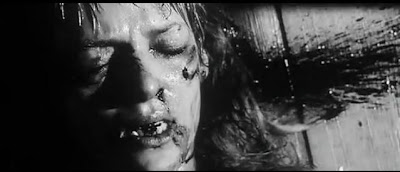


This shot is the last shown in the opening scene (The Cliffhanger). This shot is very effective as it shows the Bride being shot in the head, this leaves the audience wanting to find out more about why she has been shot in the head and what prompted Bill to do so. Many would doubt that after being shot in the head from close range that you would survive, this is what later engrosses the film. The fact that in the next scene in the film the Bride is shown alive and well suggests to the audience that the Bride is different and will play a big role in the film. The blood in this shot creates a chiaroscuro effect as the non-ambient light easily reflects off of the liquid, creating the light on dark, or in other words noir lighting. When watching this scene of the film a gun is heard to be being loaded, this subtly prepares the audience for what is going to happen next and builds up tension leading to this point. One way in which Tarantino challenges generic conventions within Kill Bill is choosing a strong female character to play the lead role.


Monday, 6 January 2014

Jackie Brown Case Study


Jackie Brown Case Study

How Tarantino uses generic conventions in 'Jackie Brown'

Jackie Brown

Director: Quentin Tarantino 
Writers: Quentin Tarantino (written for screen) , Elmore Leonard (novel)
Stars: Pam Grier, Samuel L. Jackson, Robert Di Niro, Robert Forster, Bridget Fonda, Michael Keaton 
Rating: 7.5/10 based upon the ratings of 179006 IMDb users 

Story line 

44 year old flight attendant Jackie Brown gets caught with gun dealer Ordell Robbie's money and to get the ATF off her back she sets up Ordell with her new friend, a bail bondsman named Max Cherry. But what the ATF doesn't know, is that they are part of her wild plan to get Ordell's half million dollars and get off scott free. However, she has to do it under the noses of both Ordell, the ATF man and a local cop. What she doesn't know is Ordell's blonde beach bunny wants the money for herself as does Ordell's ex-con friend.

The title sequence at the beginning of Jackie Brown is one of the longest in film history, for a vast quantity of the title sequence a tracking shot is used. During the title sequence Tarantino establishes the character of Jackie as a very strong and independent woman who is comfortable within herself. The way in which Tarantino does this is never taking the camera angle above her shoulder line because this means we are never looking down on her. Tarantino uses a low angle shot to establish her presence and amount of power. I feel that this is a useful convention used by Tarantino because it shows that Jackie is her own woman and goes against stereotypical views about women in Thrillers, the history being that women should been seen and not heard and Jackie challenges this throughout the film and defies this stereotypical view. Jackie's posture is sophisticated and she looks confident in her own body which shows her importance in her job role.


In the opening title sequence the camera never leaves Jackie at any point and is always solely fixed on her, the audience get the feel that they need to keep an eye on her throughout the film. In this particular shot Jackie is shown to be wearing high heels and her work uniform,this makes her look like a femme fatale because she looks seductive and like a strong woman. The fact that Tarantino has got Jackie walking the opposite way to the majority of the crowd suggests to us an audience that she isn't afraid to stand out in her surrounding environment. Jackie's posture is very upright and sophisticated in this shot which makes her look confident in her own body which is an important factor in her job role. The film title is based around this one character which shows she has priority over other characters in the film and is an important character. These long tracking shots show that she is the center of attention.


The other main female character in Jackie Brown is Melanie. Similar to the character of Jackie Melanie is a strong willed and confident character. Even though Melanie is dominated by two strong minded male characters in the film she still shows no real fear towards them and isn't afraid to voice her opinion and do what she wants to.


Melanie is pictured wearing a bright coloured bikini in this shot which makes her figure look eye catching and interesting, it also shows that she is vibrant and bold as an individual. By drawing the audiences eyes to her body it creates a smaller status and draws attention away from her speech and focuses on her body. The representation of Melanie is generic to the thriller genre because it is put across to us as an audience that she doesn't hold much authority or status, this is done by showing a close up of her hands and feet on the table before focusing on her face.


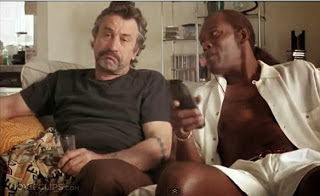
In this scene of Jackie Brown the audience is introduced to the two characters Robbie and Louis who later go onto play key roles within the film. The first impression we get of the two characters is that they are very laid back/lazy due to their slouched posture. The two characters are sat watching a program titled 'Girls with Guns'. When watching the program the two seem to be more focused on the guns rather than the half naked girls pictured, this suggests that they are more interested in the guns which is downgrading to women and fits the generic convention of women in thrillers. We also get hints that these two men could be involved in a lot of illegal, hit men type work as Robbie seems to have a large amount of knowledge about the guns in the film which suggests he either deals with them or uses them himself. During this scene Melanie is in the room also but no conversation is made with her what so ever therefore this suggests that they don't value her opinion on what is being discussed and yet again backs up the historical convention that women should be seen and not heard. They order Melanie to refill their drinks whenever required, much like a waitress and also to answer the phone for them which displays dominance on the male behalf.


In this shot a low angle shot is used from the boot of the car looking up words at the Ordell and his victim. The shot is purposely filmed from the boot of the car as that is where the victim has just come from and Tarantino wants us to get an impression of what it felt like for him, it also creates a claustrophobic atmosphere which then creates an uncertain atmosphere. The camera shows the two characters with a pitch black backdrop, this chiaroscuro lighting creates a sense of fear. The contrast of the two colours black and white is used to great effect here as the deadly weapon stands out more as it clearly displayed on a white backdrop. This means the gun will clearly become a vital prop in for the rest of the film which creates suspense for the audience. Finally a generic thriller convention in this shot that Tarantino uses throughout his films are props. in this case the monstrous, intimidating gun being held by Ordell, a gun being a very common prop being used in Thriller films


This is the scene in which Ordell murder Beaument. In this scene of the film an extreme long shot is used, this suggests a certain isolation and solitude about the character of Ordell because a large empty space is shown with just Ordell and his car. This connotes how detached from the world he is and how far away he is from humanity (emphasized by the long shot). The long shot helps to establish a location for the audience, in this case a dark and deserted wide pan of land; a perfect location to carry out such a murder.


Tuesday, 10 December 2013

Essex Boys Case Study

Essex Boys Case Study - How do aspects establish the genre?


Essex Boys

Director: Terry Winsor 
Genre: Crime Thriller 
Writers: Jeff Pope, Terry Winsor 
Stars: Charlie Creed-Miles, Sean Bean, Gareth Milne
Rating: 5.9/10 from 2457 users of IMBD. 

Storyline

The film is based loosely around events in December 1995 that culminated in the murders of three drug dealers in Rettendon, Essex, UK. On 6th December Patrick Tate, Craig Rolfe and Tony Tucker, three drug dealers well known to the police, were lured to Workhouse Lane, Rettendon. There they were blasted to death with a shot gun while sitting in their Range Rover. They had been lured to their deaths on the pretext of a lucrative drugs deal. The three bodies were found the following morning, 7 December 1995. This film starts off as a young taxi driver is offered a job to help a small-time hardman get a little revenge. The opening to a film automatically gives it a sense of crime and punishment which fits in perfectly with it crime thriller genre. 

Genre & Theme

The genre to Essex Boys is a thriller, but in this particular film many class it as being a Crime Thriller. The overall theme of the film is about revenge and following the daily everyday lives of 'hardnut' criminals in the place of Essex, UK. In this film i will look at how the lighting, costume location and story line have made this a successful thriller film. For example in this picture it displays claustraphobia and a sense of isolation from the rest of whats going on, which is an aspect of the film. 


Shot Analysis

This is the opening title sequence at the beginning of film. Immediately with this we get a sense of the genre of the film due to the white scratches shown on the screen, these could suggest knife slashes, giving a sense of fore boding as to what is to come. These lines are quite chilling and would strike fear into the audience. 

The white writing presented on the black background, presents a tribute to the classic noir thriller and chiroscuro lighting. This helps to add a sinister feeling to the thriller. 

Another interpritation that could be related to the white scratches at the beginning of film could be someones nails scratching down the screen, almost like the classic nails being dragged aggressively down a whiteboard. This may have been done to imply a certain amount of desperation and struggle to find a way out which then leads on later on into the film. 


Throughout the film Essex Boys, there is effective lighting which creates different feelings throughout. This particular scene where Jamie is standing in front of the car, seen from the perspective of Billy sat in the car. The position in which Jamie is standing makes the light shine directly on him to demonstrate his importance and power over Billy. 

We catch our first glimce of hardman ' Jason when the dirt is wiped from the car windscreen, this is key in letting us understand what type of character Jason is because he appears from a layer of thick dirt, some of it still being left on the screen, this shows the audience he isn't a very pleasant character, the dirt connotates a dark personality along with the feeling that Jason is dangerous and filthy, perhaps because of his stretch in prison and his brash actions.

In this particular shot shown below, it is a POV shot from Billy, this shot is used to create an impression of power and control, of which are attributes of Jason. On the other end of this shot is the audience who are made to feel insignificent and vulnerable when presented with the character of Jason. This is essential in any thriller film as it gives you the element of fear and makes you realise that events like these can and did happen in real life. 

Establishing a character early on in a thriller film is essential, this is done in this shot by there being glass used in between the two characters, this suggests that he is too dangerous to be dealt with without some form of defence in between one another and it also suggests his detachment from emotions from other people and his surroundings. All of these factors immediately suggest to an audience that he could be a bad guy. 


Non - ambient lighting is being used in this particular shot from Essex Boys, this dimly lights up the garage but still allows the audience to see what is going on, yet still a sense of gloominess is still upon the room. Non ambient lighting is very often seen in thriller films, and in particular in Noir thrillers. In using non ambient lighting the director (Terry Windsor) is using generic conventions to establish the genre within the first few minutes of the film. 

In this garage scene of Essex Boys, Windsor has chosen to the use the generic convention setting of a garage. He has done this because it is a claustraphobic space creating the sense of entrapment and tension. Clasutraphobic spaces can be used in thrillers to make the audience feel a characters vulnerability and sense of  no escape. The audience are able to imagine themselves in this situation and makes it more exciting to watch. 


Shown here is a long tunnel through which Billy drives with Jason as a passenger, the long tunnel suggests that the driver can't turn back and has to drive completely through the tunnel as there's no where else to go. The tunnel could connote the moral darkness of the events that are to come in that it seems never ending and that you are stuck with something you can't escape. 

 A generic convention that is very often used in thrillers is the vanishing point, a vanishing point is being displayed in this image towards the end of the tunnel. A very famous noir thriller where a vanishing point was used would be in 'The Third Man' when in the sewer scene. You get a sense from this that the audience are willing Billy not to drive down this tunnel because it is almost like a one way ticket to a life of crime influenced by Jason. 

Windsor has chosen to use a rather narrow tunnel to yet again create a clasutraphobic location and to imply that Billy is now trapped with a bad guy and there is no getting out of it, almost as if the audience are following them into a rabbit hole. It is like Billy is driving down a one way road and there is no turning back, driving down this road will lead Billy into being influenced by Jason and turning into a bad person, the tunnel has two exits therefore escape would be very difficult. 


In this scene from Essex Boys Jason is seen wearing a bright, vibrant yellow colored shirt which really epitimises and symbolises his confidence and comfort when doing his job. This yellow shirt throughout the film makes him stand out from the others in the film as most we see are either dressed in white or black which suggests he is a character that stands out from the crowd and isn't afraid to be seen or talked about. He wants to appear as having the 'bling' lifestyle in order to show his authority over his peers. 

Another key thing I noticed about this particular screenshot was the body language of Jason. This shows his confidence and his comfort in carrying out his job, although it involves work that would make most people reckless and shaken. Another point this body language proves is his dominance over fellow character Billy, he has hired Billy to drive him around where he pleases even though he could probably do it himself, and he is also isn't paying Billy so this suggests that Billy is doing it purely out of fear of Jason which tells us a lot about his character. 

For the second time in the film Jason is yet again shown behind a pane of glass, to yet again show us his detatchment from the rest of the world. We also see more about his isolated personality as he is shown to be sat alone in the back of the car.


In this scene it is almost as if Jason seems to own the ground he is standing on and is very dominant over his area. The Essex marshes which is where this scene is set are very open but also extremely isolated as there is no human activity for miles to be seen and the location is very much detatched from the rest of the world. This location could represent Jason's detatched personality. This a chilling location because there is no where to hide, it is completely open showing that there really is no escape from the predator. The location is shouting to the audience "danger". 

Wednesday, 4 December 2013

Thriller Locations

Thriller Film Locations
St James's Hill

This particular location was chosen as to where to film our cliff hanging scene. St James's hill is a wide open space that shows a canvas view of the city. It is a place where perhaps people go to get away and enjoy the view and our actress is doing exactly that in the form of trying to escape her follower. 
Anglia Square

Anglia square has a certain derelict feel to it. It's buildings including the one shown above are mostly abandoned so are perfect for our filming as they portray as sense of isolation and companionless. This also will mean that few members of the public will interfere with our filming.
Anglia Square

This underpass located in Anglia Square creates a sense of claustrophobia for us when filming creating a sense that there is no escape from the actresses stalker. 

Anglia Square Car Park

Within Anglia Square car park we are able to use their lift facility in order to aid the filming of our dead body holding the 'run' sign clutched in his hand. Yet again the car park is a rather claustrophobic space with dull lighting. 


Anglia Square Car Park (inside)
  
Inside the car park there are a vast amount of corners and places to hide for the stalker. This creates a sense of confusion for our actress. As shown in the picture the lighting is very dull which suits our genre of film. 

St Stephens Underpass

We use two underpasses in our filming, the first being St Stephens (shown above) and the second being Anglia Square. Just like Anglia Square underpass, this displays a sense of claustrophobia and as if there is no way in which to escape.