Monday, 6 January 2014

Jackie Brown Case Study


Jackie Brown Case Study

How Tarantino uses generic conventions in 'Jackie Brown'

Jackie Brown

Director: Quentin Tarantino 
Writers: Quentin Tarantino (written for screen) , Elmore Leonard (novel)
Stars: Pam Grier, Samuel L. Jackson, Robert Di Niro, Robert Forster, Bridget Fonda, Michael Keaton 
Rating: 7.5/10 based upon the ratings of 179006 IMDb users 

Story line 

44 year old flight attendant Jackie Brown gets caught with gun dealer Ordell Robbie's money and to get the ATF off her back she sets up Ordell with her new friend, a bail bondsman named Max Cherry. But what the ATF doesn't know, is that they are part of her wild plan to get Ordell's half million dollars and get off scott free. However, she has to do it under the noses of both Ordell, the ATF man and a local cop. What she doesn't know is Ordell's blonde beach bunny wants the money for herself as does Ordell's ex-con friend.

The title sequence at the beginning of Jackie Brown is one of the longest in film history, for a vast quantity of the title sequence a tracking shot is used. During the title sequence Tarantino establishes the character of Jackie as a very strong and independent woman who is comfortable within herself. The way in which Tarantino does this is never taking the camera angle above her shoulder line because this means we are never looking down on her. Tarantino uses a low angle shot to establish her presence and amount of power. I feel that this is a useful convention used by Tarantino because it shows that Jackie is her own woman and goes against stereotypical views about women in Thrillers, the history being that women should been seen and not heard and Jackie challenges this throughout the film and defies this stereotypical view. Jackie's posture is sophisticated and she looks confident in her own body which shows her importance in her job role.


In the opening title sequence the camera never leaves Jackie at any point and is always solely fixed on her, the audience get the feel that they need to keep an eye on her throughout the film. In this particular shot Jackie is shown to be wearing high heels and her work uniform,this makes her look like a femme fatale because she looks seductive and like a strong woman. The fact that Tarantino has got Jackie walking the opposite way to the majority of the crowd suggests to us an audience that she isn't afraid to stand out in her surrounding environment. Jackie's posture is very upright and sophisticated in this shot which makes her look confident in her own body which is an important factor in her job role. The film title is based around this one character which shows she has priority over other characters in the film and is an important character. These long tracking shots show that she is the center of attention.


The other main female character in Jackie Brown is Melanie. Similar to the character of Jackie Melanie is a strong willed and confident character. Even though Melanie is dominated by two strong minded male characters in the film she still shows no real fear towards them and isn't afraid to voice her opinion and do what she wants to.


Melanie is pictured wearing a bright coloured bikini in this shot which makes her figure look eye catching and interesting, it also shows that she is vibrant and bold as an individual. By drawing the audiences eyes to her body it creates a smaller status and draws attention away from her speech and focuses on her body. The representation of Melanie is generic to the thriller genre because it is put across to us as an audience that she doesn't hold much authority or status, this is done by showing a close up of her hands and feet on the table before focusing on her face.


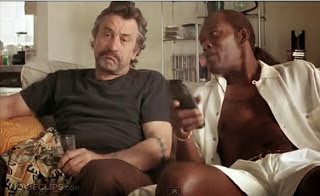
In this scene of Jackie Brown the audience is introduced to the two characters Robbie and Louis who later go onto play key roles within the film. The first impression we get of the two characters is that they are very laid back/lazy due to their slouched posture. The two characters are sat watching a program titled 'Girls with Guns'. When watching the program the two seem to be more focused on the guns rather than the half naked girls pictured, this suggests that they are more interested in the guns which is downgrading to women and fits the generic convention of women in thrillers. We also get hints that these two men could be involved in a lot of illegal, hit men type work as Robbie seems to have a large amount of knowledge about the guns in the film which suggests he either deals with them or uses them himself. During this scene Melanie is in the room also but no conversation is made with her what so ever therefore this suggests that they don't value her opinion on what is being discussed and yet again backs up the historical convention that women should be seen and not heard. They order Melanie to refill their drinks whenever required, much like a waitress and also to answer the phone for them which displays dominance on the male behalf.


In this shot a low angle shot is used from the boot of the car looking up words at the Ordell and his victim. The shot is purposely filmed from the boot of the car as that is where the victim has just come from and Tarantino wants us to get an impression of what it felt like for him, it also creates a claustrophobic atmosphere which then creates an uncertain atmosphere. The camera shows the two characters with a pitch black backdrop, this chiaroscuro lighting creates a sense of fear. The contrast of the two colours black and white is used to great effect here as the deadly weapon stands out more as it clearly displayed on a white backdrop. This means the gun will clearly become a vital prop in for the rest of the film which creates suspense for the audience. Finally a generic thriller convention in this shot that Tarantino uses throughout his films are props. in this case the monstrous, intimidating gun being held by Ordell, a gun being a very common prop being used in Thriller films


This is the scene in which Ordell murder Beaument. In this scene of the film an extreme long shot is used, this suggests a certain isolation and solitude about the character of Ordell because a large empty space is shown with just Ordell and his car. This connotes how detached from the world he is and how far away he is from humanity (emphasized by the long shot). The long shot helps to establish a location for the audience, in this case a dark and deserted wide pan of land; a perfect location to carry out such a murder.


Tuesday, 10 December 2013

Essex Boys Case Study

Essex Boys Case Study - How do aspects establish the genre?


Essex Boys

Director: Terry Winsor 
Genre: Crime Thriller 
Writers: Jeff Pope, Terry Winsor 
Stars: Charlie Creed-Miles, Sean Bean, Gareth Milne
Rating: 5.9/10 from 2457 users of IMBD. 

Storyline

The film is based loosely around events in December 1995 that culminated in the murders of three drug dealers in Rettendon, Essex, UK. On 6th December Patrick Tate, Craig Rolfe and Tony Tucker, three drug dealers well known to the police, were lured to Workhouse Lane, Rettendon. There they were blasted to death with a shot gun while sitting in their Range Rover. They had been lured to their deaths on the pretext of a lucrative drugs deal. The three bodies were found the following morning, 7 December 1995. This film starts off as a young taxi driver is offered a job to help a small-time hardman get a little revenge. The opening to a film automatically gives it a sense of crime and punishment which fits in perfectly with it crime thriller genre. 

Genre & Theme

The genre to Essex Boys is a thriller, but in this particular film many class it as being a Crime Thriller. The overall theme of the film is about revenge and following the daily everyday lives of 'hardnut' criminals in the place of Essex, UK. In this film i will look at how the lighting, costume location and story line have made this a successful thriller film. For example in this picture it displays claustraphobia and a sense of isolation from the rest of whats going on, which is an aspect of the film. 


Shot Analysis

This is the opening title sequence at the beginning of film. Immediately with this we get a sense of the genre of the film due to the white scratches shown on the screen, these could suggest knife slashes, giving a sense of fore boding as to what is to come. These lines are quite chilling and would strike fear into the audience. 

The white writing presented on the black background, presents a tribute to the classic noir thriller and chiroscuro lighting. This helps to add a sinister feeling to the thriller. 

Another interpritation that could be related to the white scratches at the beginning of film could be someones nails scratching down the screen, almost like the classic nails being dragged aggressively down a whiteboard. This may have been done to imply a certain amount of desperation and struggle to find a way out which then leads on later on into the film. 


Throughout the film Essex Boys, there is effective lighting which creates different feelings throughout. This particular scene where Jamie is standing in front of the car, seen from the perspective of Billy sat in the car. The position in which Jamie is standing makes the light shine directly on him to demonstrate his importance and power over Billy. 

We catch our first glimce of hardman ' Jason when the dirt is wiped from the car windscreen, this is key in letting us understand what type of character Jason is because he appears from a layer of thick dirt, some of it still being left on the screen, this shows the audience he isn't a very pleasant character, the dirt connotates a dark personality along with the feeling that Jason is dangerous and filthy, perhaps because of his stretch in prison and his brash actions.

In this particular shot shown below, it is a POV shot from Billy, this shot is used to create an impression of power and control, of which are attributes of Jason. On the other end of this shot is the audience who are made to feel insignificent and vulnerable when presented with the character of Jason. This is essential in any thriller film as it gives you the element of fear and makes you realise that events like these can and did happen in real life. 

Establishing a character early on in a thriller film is essential, this is done in this shot by there being glass used in between the two characters, this suggests that he is too dangerous to be dealt with without some form of defence in between one another and it also suggests his detachment from emotions from other people and his surroundings. All of these factors immediately suggest to an audience that he could be a bad guy. 


Non - ambient lighting is being used in this particular shot from Essex Boys, this dimly lights up the garage but still allows the audience to see what is going on, yet still a sense of gloominess is still upon the room. Non ambient lighting is very often seen in thriller films, and in particular in Noir thrillers. In using non ambient lighting the director (Terry Windsor) is using generic conventions to establish the genre within the first few minutes of the film. 

In this garage scene of Essex Boys, Windsor has chosen to the use the generic convention setting of a garage. He has done this because it is a claustraphobic space creating the sense of entrapment and tension. Clasutraphobic spaces can be used in thrillers to make the audience feel a characters vulnerability and sense of  no escape. The audience are able to imagine themselves in this situation and makes it more exciting to watch. 


Shown here is a long tunnel through which Billy drives with Jason as a passenger, the long tunnel suggests that the driver can't turn back and has to drive completely through the tunnel as there's no where else to go. The tunnel could connote the moral darkness of the events that are to come in that it seems never ending and that you are stuck with something you can't escape. 

 A generic convention that is very often used in thrillers is the vanishing point, a vanishing point is being displayed in this image towards the end of the tunnel. A very famous noir thriller where a vanishing point was used would be in 'The Third Man' when in the sewer scene. You get a sense from this that the audience are willing Billy not to drive down this tunnel because it is almost like a one way ticket to a life of crime influenced by Jason. 

Windsor has chosen to use a rather narrow tunnel to yet again create a clasutraphobic location and to imply that Billy is now trapped with a bad guy and there is no getting out of it, almost as if the audience are following them into a rabbit hole. It is like Billy is driving down a one way road and there is no turning back, driving down this road will lead Billy into being influenced by Jason and turning into a bad person, the tunnel has two exits therefore escape would be very difficult. 


In this scene from Essex Boys Jason is seen wearing a bright, vibrant yellow colored shirt which really epitimises and symbolises his confidence and comfort when doing his job. This yellow shirt throughout the film makes him stand out from the others in the film as most we see are either dressed in white or black which suggests he is a character that stands out from the crowd and isn't afraid to be seen or talked about. He wants to appear as having the 'bling' lifestyle in order to show his authority over his peers. 

Another key thing I noticed about this particular screenshot was the body language of Jason. This shows his confidence and his comfort in carrying out his job, although it involves work that would make most people reckless and shaken. Another point this body language proves is his dominance over fellow character Billy, he has hired Billy to drive him around where he pleases even though he could probably do it himself, and he is also isn't paying Billy so this suggests that Billy is doing it purely out of fear of Jason which tells us a lot about his character. 

For the second time in the film Jason is yet again shown behind a pane of glass, to yet again show us his detatchment from the rest of the world. We also see more about his isolated personality as he is shown to be sat alone in the back of the car.


In this scene it is almost as if Jason seems to own the ground he is standing on and is very dominant over his area. The Essex marshes which is where this scene is set are very open but also extremely isolated as there is no human activity for miles to be seen and the location is very much detatched from the rest of the world. This location could represent Jason's detatched personality. This a chilling location because there is no where to hide, it is completely open showing that there really is no escape from the predator. The location is shouting to the audience "danger". 

Wednesday, 4 December 2013

Thriller Locations

Thriller Film Locations
St James's Hill

This particular location was chosen as to where to film our cliff hanging scene. St James's hill is a wide open space that shows a canvas view of the city. It is a place where perhaps people go to get away and enjoy the view and our actress is doing exactly that in the form of trying to escape her follower. 
Anglia Square

Anglia square has a certain derelict feel to it. It's buildings including the one shown above are mostly abandoned so are perfect for our filming as they portray as sense of isolation and companionless. This also will mean that few members of the public will interfere with our filming.
Anglia Square

This underpass located in Anglia Square creates a sense of claustrophobia for us when filming creating a sense that there is no escape from the actresses stalker. 

Anglia Square Car Park

Within Anglia Square car park we are able to use their lift facility in order to aid the filming of our dead body holding the 'run' sign clutched in his hand. Yet again the car park is a rather claustrophobic space with dull lighting. 


Anglia Square Car Park (inside)
  
Inside the car park there are a vast amount of corners and places to hide for the stalker. This creates a sense of confusion for our actress. As shown in the picture the lighting is very dull which suits our genre of film. 

St Stephens Underpass

We use two underpasses in our filming, the first being St Stephens (shown above) and the second being Anglia Square. Just like Anglia Square underpass, this displays a sense of claustrophobia and as if there is no way in which to escape. 

Planning

Thriller Planning
Myself, Luke and Holly have decided base our thriller film around someone getting followed and to a certain extent stalked creating suspense and then eventually leading to a cliff hanging conclusion. Our thriller film consists of three main characters, Character A being the person who is being followed/stalked, character B being the follower and character C being a civilian who suspects something suspicious and tries to aid the girl being stalked. (We are yet to generate names for our characters).

 Throughout our thriller film we use a number of varied locations around Norwich, these include St. Stephens underpass, Anglia Square, and St James's hill. Our thriller film starts off with an over the shoulder shot of character B following character A through the underpass, we have chosen to do this because it is a confined suspense and creates a sense of claustraphobia and giving character A no place to escape from her follower. The over the shoulder shot is perfect because it implies that she is being followed which she is. The shot then moves to Anglia Square, where the majority of our shooting will be done. In Anglia Square there are a number of useful, derelic buildings and we use these in our shooting. By this point the girl has suspected something unsusual about her situation and has purposely taken a different route home in order to loose her stalker, she realises her plan isnt working so takes another option and enters an abandoned car park in Anglia Square hoping she is not followed in there, a nearby civilian see's that this girl is being followed and decides to step in so follows them both to check what is going on.

The girl enters the lift in order to escape and takes it to the very top of the car park, this way she can get a clear view of her surroundings and possibly locate her stalker. As she is looking out she hears the opening of the lift doors, fearing the worst she believes it could be her stalker but she is wrong as she goes over she finds a dead body of the civilian trying to help her. But there is something unusual about the body, attatched to it, is a note saying 'run' and then the girl realises that this man is very dangerous, at this point we still dont know who this man is. She flees Anglia Square and reaches St James's hill (city view) up here she has a wide view of the city skyline and as shes looking out of the city we bring in an over the shoulder shot of a hand reasting on the girls shoulder and she turns around in fright, we end the filming and leave it as a cliff hanger.
Lighting: Ambient, non - ambient, cirosquera
Locations: St Stephens, Grapes Hill, Anglia Square, St Jame's Hill
Actors: Character A (girl) Character B (man) Character C (man)
Shot types: Tilt shot, Medium close up, Close up, Over the shoulder, extreme close up, long shot, worms eye view.

Tuesday, 12 November 2013

Independent Film Reviews


Independent Film Reviews

Pulp Fiction
Release date: 21st October 1994
Starring: Tim Roth, Amanda Plummer, Laura Loveface, John Travolta, Samuel L. Jackson

Pulp: the word itself conveys a sense of roughness, grittiness, blood and gore, and some serious edge. Pulp Fiction is very liberal with its violence - going so far as having good guys, bad guys, and innocent bystanders getting shot up without any legal consequences. The film is also very liberal with its bad language - there are F-bombs and sexual dialogue galore. Parts of the film are pretty shocking. Make no mistake, there is definitely a lot of pulp in Pulp Fiction. 


Beneath its blood-soaked surface, the film can be surprisingly light and upbeat, thanks to its playfully witty dialogue and constant stream of ironic situations. It is a comedy at its core - not a comedy that ever makes me laugh out loud, but there are plenty of memorable and amusing lines throughout. Above all, it's just funny the way things turn out in this film. Seemingly unrelated characters run into each other, crazy stuff happens, and the outcome can be quite surprising at times.

That being said, I've always felt this film has a pretty weird and random series of stories. It's a series of nested short stories - one story starts, then another, then another, then it goes back to the previous one, until finally connecting back to the scene in the film's opening. The narrative is purposefully mixed-up, jumping around a few different characters with their own situations, which ultimately connects to each other. Each story is pretty interesting though: the bulk of the film focuses on a pair of hitmen, who terrorize and murder some dudes to retrieve a mysterious briefcase. This story is ultimately interrupted by the next, in which one of the hitmen takes the crime boss' wife out, and interesting occurrences take place (including some of the best dancing ever). My favorite of the lot is the episode involving the golden watch, in which a boxer tries to flee from town to evade the boss' wrath, but has to go back to retrieve his father's pocketwatch. Crazy things ensue. The film's last stretch returns to the briefcase situation, in which even crazier things ensue, and the characters contemplate the greater meaning of everything that's happened. 

This film uses pretty solid photography and interesting editing. I feel it captures the ambiance of the locales extremely well. Acting is strong: John Travolta, Samuel L. Jackson, Bruce Willis, and Uma Thurman are all striking in their respective roles. Writing shows excellent wit, with its plethora of great lines and conversation, and great nuance, with its plotting and narrative. This production has very real-looking sets, props, and costumes.


Reservoir Dogs

Reservoir Dogs (1992) Poster
Release date: 21st January 1992 (USA) 
Director: Quentin Tarantino 
Starring: Harvey Keitel, Tim Roth, Michael Madsen, Chris Penn, Steve Buscemi 

 'After a simple jewelery heist goes terribly wrong, the surviving criminals begin to suspect that one of them is a police informant.'

Reservoir dogs (directed by Quentin Tarantino) is about Six criminals, who are strangers to each other, are hired by a crime boss Joe Cabot to carry out a diamond robbery. Right at the outset, they are given false names with an intention that they won't get too close and concentrate on the job instead. They are completely sure that the robbery is going to be a success. But when the police show up right at the time and the site of the robbery, panic spreads amongst the group members and one of them is killed in the subsequent shootout along with a few policemen and civilians. When the remaining people assemble at the premeditated rendezvous point (a warehouse), they begin to suspect that one of them is an undercover cop. 

The movie has earned itself a reputation as a violent picture and provided a convenient platform for some hysterical media reaction. As is often the case, viewing reveals a different truth. And the classic and sadly underused technique of implied action suggests a more powerful horror than you can actually see.

The film essentially revolves around a robbery that has gone wrong. Abandoning the conventional format of natural chronological storytelling, Tarantino creates a series of flashbacks that cleverly build to a conclusion. This allows separate scenes to be showcased as individual masterpieces that the cast exploit to the full.

The opening scene features an endlessly circling camera, as the tough guys light cigarettes and drink coffee in one of those places where the tables are Formica and the waitresses write your order on a green-and-white Guest Check. They argue, joke and b.s. each other through thick clouds of smoke; it's like "The Sportswriters on Parole." There's a funny discussion of tipping. Then they walk out of the restaurant, and are introduced in the opening credits, as they walk menacingly toward the camera. They have great faces: The glowering Michael Madsen; the apprehensive Tim Roth; Chris Penn, ready for anything; Tierney, with a Mack truck of a mug; Harvey Keitel, whose presence in a crime movie is like an imprimatur.

The movie feels like it's going to be terrific, but Tarantino's script doesn't have much curiosity about these guys. He has an idea, and trusts the idea to drive the plot.

The idea is that the tough guys, except for Tierney and the deranged Madsen, are mostly bluffers. They are not good at handling themselves in desperate situations.


We see the bungled crime in flashbacks. Tarantino has a confident, kinetic way of shooting action - guys running down the street, gun battles, blood and screams. Then the action centers in the warehouse, where Madsen sadistically toys with a character he thinks is a cop.


The Godfather


Release date: 15th March 1972
Director: Francis Ford Coppola 
Starring: Marlon Brando, Al Pacino, James Caan, Richard Castellano, Robert Duvall

'The aging patriarch of an organized crime dynasty transfers control of his clandestine empire to his reluctant son.' 

The story begins as "Don" Vito Corleone, the head of a New York Mafia "family", oversees his daughter's wedding with his wife Wendy. His beloved son Michael has just come home from the war, but does not intend to become part of his father's business. Through Michael's life the nature of the family business becomes clear. The business of the family is just like the head of the family, kind and benevolent to those who give respect, but given to ruthless violence whenever anything stands against the good of the family.

The story views the Mafia from the inside. That is its secret, its charm, its spell; in a way, it has shaped the public perception of the Mafia ever since. The real world is replaced by an authoritarian patriarchy where power and justice flow from the Godfather, and the only villains are traitors. There is one commandment, spoken by Michael (Al Pacino): “Don’t ever take sides against the family.”

It is significant that the first shot is inside a dark, shuttered room. It is the wedding day of Vito Corleone’s daughter, and on such a day a Sicilian must grant any reasonable request. A man has come to ask for punishment for his daughter’s rapist. Don Vito asks why he did not come to him immediately and the plot thickens. With the end of the war, the times are changing, and as much as Don Vito seems in control at the wedding, his power is beginning to erode. By the standards of some, his views on the importance of family, loyalty, and respect are antiquated. Even his heir apparent, Sonny, disagrees with his refusal to get into the drug business. Gambling and alcohol are forces of the past and present; narcotics are the future. But Don Vito will not compromise, even when a powerful drug supplier named Sollozzo (Al Lettieri) arrives with promises of high profits for those who back him. 
Don Vito is a most complicated gangster. In his own words, he is not a killer, and he never mixes business with personal matters. He puts family first ("A man who doesn't spend time with his family can never be a real man") and despises displays of weakness. He understands the burden of power, and his wordless sympathy for Michael when he is forced to assume the "throne", is one of The Godfather's most revealing moments (about both father and son).The Godfather had three Best Supporting Actor nominees, all well-deserved in my opinion. The first was Pacino (who probably should have been nominated alongside Brando in the Best Actor category). The other two were James Caan and Robert Duvall. In a way, it's surprising that Duvall wasn't passed over. His presence in The Godfather isn't flashy or attention-arresting. Like his character of Tom Hagen, he is steady, reliable, and stays in the background. Not so for Caan's Sonny, whose demonstrative and volatile personality can't be overlooked. In a conclusion I feel the Godfather is an outstanding film with plot twists throughout and brilliant directing and acting making it a top film.